Table of Contents
What most of us don't realise is that so much of leadership happens through conversation. Not through presentations or emails. But through the living exchange between people, where we meet each other and where something new can emerge that neither person saw coming.
Decisions are made, relationships are shaped, trust is built, and futures are created through the words we speak and the quality of presence we bring. Many leaders are taught to communicate clearly, persuade effectively, and give direction. All of that matters. But there comes a moment when we begin to recognize that conversational leadership is not simply about exchanging information.
Conversation shapes reality. The way we speak and the way we listen influences what becomes thinkable, sayable, and possible between people.
Understanding Conversational Leadership: More Than Communication
Conversational leadership isn't about techniques for better meetings or scripts for difficult conversations. It's about recognizing that leadership happens primarily through the quality of dialogue we create.
Most leadership development focuses on what to say, including how to deliver feedback, how to articulate vision, how to communicate during change. These skills have their place. But conversational leadership asks a different question: What quality of space am I creating through my presence and attention?
The quality of conversation directly impacts team innovation, psychological safety, and performance. When conversation flows freely, when diverse perspectives emerge, when people think together rather than defend positions, something different becomes possible.
This is grounded in a relational approach to leadership that recognizes how we are being shapes the quality of conversation we create. Conversational leadership is ontological in nature. It's not just about saying the right words. It's about who you're being when you enter a conversation. Are you bringing curiosity or certainty? Spaciousness or urgency? A genuine question or a disguised directive?
Your team can feel the difference. The quality of your presence creates or closes the conversational field before you speak a single word.

How Conversational Leadership Shapes What's Possible
Every conversation creates or closes possibility. When urgency or anxiety is present, conversations often become narrow. We move quickly into fixing, explaining, correcting, or defending. Others become quieter. More cautious. Less willing to contribute. Over time, collaboration gives way to compliance. Creativity slowly disappears. Innovation becomes something we talk about wanting but struggle to actually experience.
What's happening?
The conversational field has collapsed. What feels sayable has narrowed. People learn what kind of contributions are welcome and what kind aren't. They learn to read the leader's mood, the pace, the hidden message underneath the words.
Studies in sociolinguistics and organizational theory demonstrate that language doesn't just describe reality, it creates it. The way we speak literally shapes what becomes possible. Think about your own experience. You've been in conversations where you felt free to think out loud, to wonder, to not know the answer yet. Where half-formed thoughts were welcome. Where silence was comfortable rather than awkward.
And you've been in conversations where you edited yourself before speaking. Where you knew what was appropriate to say and what wasn't. Where you waited to hear what the leader thought before offering your own view.
What was the difference?
Not just the words spoken. The quality of presence. The pacing. The leader's relationship to certainty and uncertainty. The space available for thinking together. This is what conversational leadership attends to, not just the content of conversation, but the space it creates.
The Practice of Conversational Leadership
Something different becomes possible when conversation begins from presence rather than pressure.
Conversational leadership requires working with your Way of Being which includes your presence, your mood, your embodied state, not just your communication techniques.
What makes some conversations generative while others shut down possibility?
The quality of listening. Most of us listen while thinking about what we'll say next. Or listen to evaluate whether we agree or disagree. Or listen for the gap where we can jump in with our perspective. Conversational leadership asks us to listen differently. To listen for what's emerging. To listen for what wants to be said that hasn't been said yet. To listen with genuine curiosity about what this person sees that you don't yet see.
Leaders consistently overestimate how well they listen and underestimate its impact. While we think we're listening, our team experiences something else.
The relationship to silence. In many leadership conversations, silence feels like a problem to solve and something to fill. A gap that suggests confusion or disagreement. Instead in conversational leadership, we recognise that silence can be generative. It's the space where thinking happens and where people digest what's been said. Where something new might emerge if we don't rush to fill it.
The pacing. Urgency collapses time. When a leader brings urgency to a conversation, people feel it. They speed up and move toward premature closure. They offer what's safe rather than what they really feel. Presence creates different pacing. Not slow for its own sake, but paced to match the complexity of what's being considered. Paced to allow thinking rather than just reacting.
The questions asked. Are your questions genuine invitations to think together? Or are they disguised directives, ie questions that have a right answer you're waiting for them to arrive at? "What do you think we should do about this?" when you already know what you think is not conversational leadership. It's a test.
But "What are we not seeing yet?" or "What else feels important?" or "What would need to be true for this to work?"—these are genuine invitations.
The willingness to not know. Google's Project Aristotle research found that psychological safety, largely created through conversational quality, was the single most important factor in team effectiveness. And psychological safety isn't created by a leader who has all the answers. It's created by a leader who can genuinely wonder, who can be uncertain, who can say "I don't know yet. Let's think about this together."
Conversational Leadership in Action: A Real Example
Let me share a story that shows what shifts when a leader begins practicing conversational leadership. I was working with a leader, let's call him David, who felt frustrated that his team rarely offered ideas. Meetings felt flat and he felt as though he had to carry everything himself.
"They just sit there," he said. "I ask if anyone has input, and nothing. So I end up filling the space and making the decisions." As we explored his experience, he began to see something he hadn't noticed before. When he went into meetings, he carried a subtle internal message: "We don't have time. This needs to move fast." He didn't say these words, but his team felt them.
Without meaning to, he spoke quickly, he filled silence within seconds, and he jumped to solutions before the problem was fully explored. When someone started to think out loud, he'd finish their sentence or redirect to his solution.
From his perspective, he was being helpful intending to keep things moving, preventing meandering discussions, and ensuring efficiency. From the team's perspective, there was no space to think. They learned that offering half-formed ideas was risky and that wondering out loud wasn't welcome. They intuited that David already knew what he thought, so their job was to agree or implement, not to think alongside him.
The conversational field had collapsed.
We explored a new direction. Not new techniques or scripts, but a shift in his presence and attention. He began experimenting with conversational leadership. At key points in conversations that felt appropriate, he would pause and ask: "What else feels important?" Not "Does anyone have anything to add? which can often feel like "I'm done talking, last chance before we move on." But "What else feels important?" was a genuine wondering about what might be present that hasn't yet been spoken.
He also committed to a practice outside of meetings: approaching at least one person in the team who hadn't said anything and asking for their views, creating space for reflection rather than putting them on the spot. This subtly redirected attention and invited more participation.
What happened?
Initially, nothing happened. People were used to the old pattern and they'd wait for David to fill the space, which he'd always done. But David stayed with his practice and when silence emerged, he didn't rescue it. He sat patiently and felt his own discomfort rather than filling the gap. Gradually, people started speaking. They were tentative at first and said things like "I'm not really sure, but...", and "I wonder if ....". David practiced listening without immediately evaluating or solving. "Say more about that," he'd offer. Or "What makes you think that might be important?"
Over time, people became more vocal, bringing increased creativity and innovation to the team. They also became more reflective, more generous, more available to each other. And something unexpected happened for David. He experienced a huge sense of relief. He spontaneously let go of taking on responsibility that was unnecessary and burdensome.
He learned to harness the power of conversational leadership, which includes both speaking AND LISTENING which is something we often forget. The shift came not from better communication techniques. It came from a different quality of presence that created a different conversational field.
What Shuts Down Conversational Possibility
Recognizing what closes conversational space is as important as knowing what opens it.
- Filling silence too quickly. When a leader fills every pause, they signal that silence is uncomfortable, that quick responses are valued over thoughtful ones, so people learn to speak fast or not at all.
- Finishing people's sentences. This communicates "I already know what you're going to say" or "Get to the point faster." People stop trying to articulate their thinking.
- Bringing urgency to everything. When everything is urgent, nothing gets the time and attention it actually needs. People move to superficial solutions rather than substantive thinking.
- Asking questions you've already answered. When your questions are really tests -"Let's see if they arrive at what I already think"- people feel it. They learn to guess rather than genuinely explore.
- Listening to respond rather than understand. When people can tell you're formulating your response while they're still talking, they know they're not really being heard. They shorten what they say or stop offering altogether.
- Correcting or explaining immediately. When every contribution is met with "Actually…" or "The problem with that is…"—people learn that their thinking isn't welcome. They become silent or compliant.
These patterns don't come from bad intentions. They come from pressure, urgency, anxiety, or the habit of thinking the leader's job is to have the answer. But they collapse the conversational space. They narrow what becomes possible and reduce the team's collective intelligence to the leader's individual perspective.

More Moments of Conversational Leadership
The Leader Who Learned to Wonder
Another client, a senior executive, realized she dominated every strategic conversation. Not because she meant to, but because she thought quickly and spoke confidently. Her conversational leadership practice became simple: In the first ten minutes of any strategic conversation, she would only ask questions. No statements. No solutions. Just genuine wondering.
"What are we seeing?" "What patterns are emerging?" "What aren't we talking about that we should be?"
This created space for others to think and speak first. Over time, the quality of strategic thinking in her team deepened significantly. She was surprised to discover perspectives and insights she would have missed if she'd continued leading with her own certainty.
The Team Lead Who Changed the Field
A team lead realized her team meetings felt like status reports rather than genuine collaboration. Everyone took turns presenting updates. Little actual dialogue happened. She redesigned the conversational structure. Instead of everyone presenting, the team would spend the first twenty minutes in conversation about one challenge someone was facing.
Not to solve it necessarily. Just to think about it together. She'd ask: "What does this situation reveal?" "What do we need to understand better?" "What's the opportunity we're not seeing yet?"
The conversational field shifted from reporting to genuine collective thinking. People began to trust that their wondering was welcome. The quality of problem-solving improved dramatically.
Language as Creative Act
Curiosity opens space while control narrows it. When listening and questions come from genuine interest, people feel safer. New perspectives emerge. What seemed impossible begins to feel workable.
This is what conversational leadership creates, not through force or persuasion, but through the quality of attention we bring.
Instead of trying to force possibility - an oxymoron if ever there was one - we create possibility by thinking together. With a bit more patience, a bit more humility, and a calm presence that grows over time.
Language is not just descriptive. It's creative. It doesn't just report on reality, it shapes what becomes real. When a leader says "This won't work" versus "What would need to be true for this to work?, two completely different futures open up. When a leader says "That's not the right approach" versus "Help me understand your thinking", one conversation closes, another opens.
Conversational leadership recognizes this creative power of language. And it asks us to wield it consciously, carefully, with awareness of how our words and presence shape what becomes possible for others.
Developing Your Conversational Leadership
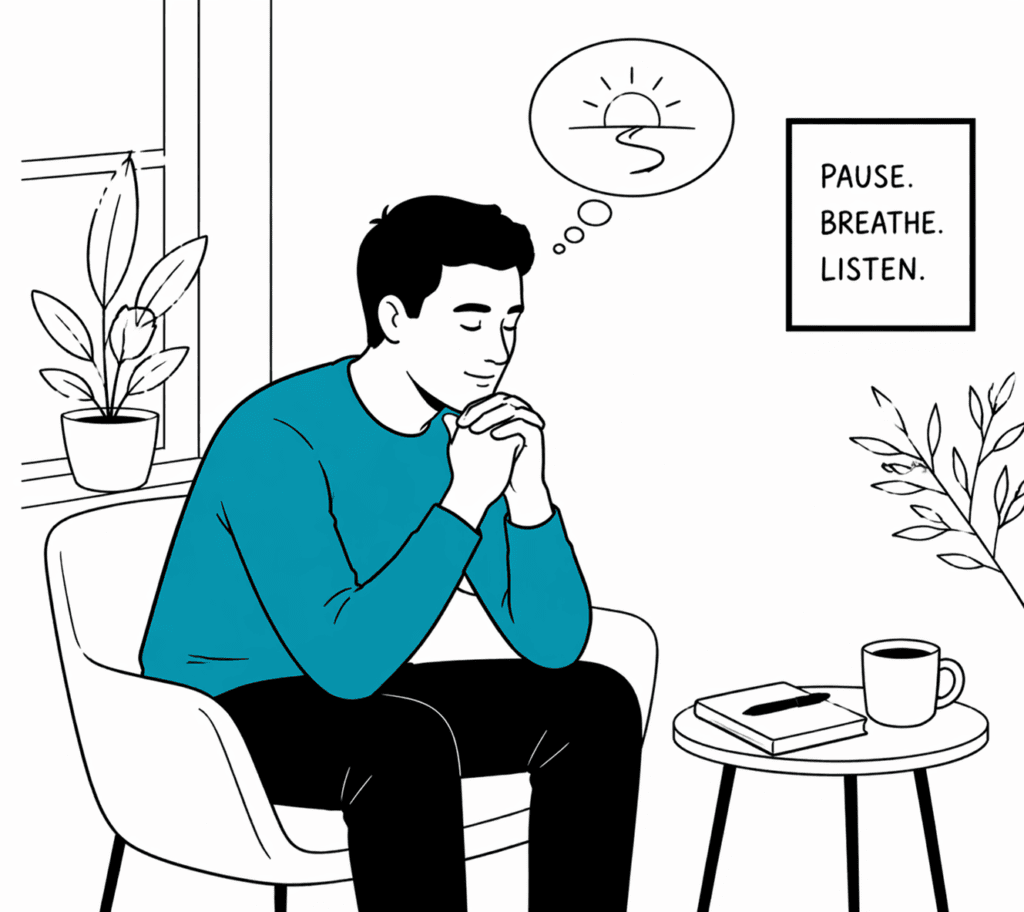
Conversational leadership is an ongoing practice. Not something you master once, but a way of being you cultivate over time.
Here are practices that support this cultivation:
- Before important conversations, pause. Notice what you're bringing. What mood? What urgency? What assumptions about what needs to happen?
- Take three breaths. Ground yourself. Ask: "What quality of conversation do I want to create here?"
- Practice listening without planning your response. When someone is speaking, notice when your attention shifts to what you'll say next. Gently bring it back to simply receiving what they're offering.
- Get comfortable with silence. When a pause emerges, count to five before speaking. Let there be space for thinking.
- Ask genuine questions. Not rhetorical questions. Not questions with right answers. But questions you're genuinely curious about. Questions that invite thinking rather than testing.
- Notice what makes you want to fill space or take control. What triggers your urgency? When do you stop listening? These are the moments where conversational leadership practice matters most.
- Invite perspectives you haven't heard. After a conversation, ask yourself: "Who didn't speak? What voices are missing? What perspectives haven't emerged?"
Then create conditions for those perspectives to surface, not by putting people on the spot, but by inviting their thinking in ways that feel safe.
Practices to support this kind of conversational leadership awareness are available in The Human Connection Store.
A Reflection
You might like to consider: "How do my conversations shape what others feel able to say?" Notice not only the words, but the pace, tone, and presence you bring.
Do people experience spaciousness or pressure in conversation with you? Do they feel invited to think alongside you, or do they wait to hear what you think first? What becomes sayable when you're present? What remains unspoken?
These aren't questions with right answers. They're invitations to ongoing awareness.
Because conversational leadership isn't a destination. It's a practice of continually attending to the quality of dialogue you create—and being willing to shift when you notice that possibility has narrowed.
The conversations you create today shape the futures that become possible tomorrow, not through force or persuasion, but through presence, patience, and genuine curiosity about what wants to emerge.